Showing posts with label survival. Show all posts

2016/04/18

Thoughts and Musings on "Black Feminism in Everyday Life" by Siobhan Brooks


I just finished really a long essay titled “Black Feminism in Everyday Life: Race, Mental Illness, Poverty and Motherhood and was written by Siobhan Brooks. This is one of the most powerful and painful readings that I have ever picked up. Schizophrenia is a very touchy topic for me on a few different levels. To read the original essay that I am reacting too, here is a link. This post is a bit convoluted and a bit personal to boot, but I certainly found lots to think about and comment on... :)


"They didn't deal with the issues of poverty and lack of education, the realities of infanticide and racism or making abortion accessible for all women"

"I think... rarely considered issues of class regarding motherhood"


I grew up very sheltered from feminists issues. In fact, a general authority of my church named "feminists" as one of the three most dangerous enemies to the church. The idea of individuals calling themselves feminists and being activists was (and still is a little) frightening to me. Contention and anger scare me a lot and activism and feminism come with both- mostly appropriately contentious, etc... as change doesn't come with silence demurring - it comes with struggle, with raised voices, and activity. It has taken over two decades for me to not only embrace many of the ideals that feminism embodies, but to feel comfortable calling myself a feminist and trying to learn to be comfortable with activism. I grew up relatively lower middle class I think and didn't really understand the idea of racism at all- to some extent I still do not ever though I do recognize some racism in myself and those around me. I understood that poverty was caused either by yourself or that God was testing you with it... but most likely a bit of both. I have heard that the US has a very high rate of infant mortality and I have never really understood that in the guise that I also here we have the best health system in the world. I also recognize that the women's movement has managed to make abortion legal, however, the reality is that abortion is for the most part only available to a small percentage of women especially as laws are passed creating more and more hurdles to obtaining it. When I read these lines I thought about how race and poverty/ class really do intersect a lot in our societies and for individuals without health insurance, so too do the problems of infanticide, fewer educational opportunities, and fewer successful ways to raise productive, happy, successful children. When I was getting divorced I discovered that women who divorce are more likely to become impoverished and adding children to the mix only increased the chances. I do struggle a lot with finances and paying the bills even though I work like mad and long enough hours that some days I come home and I am just too tired to even make anything for my dinner.

In many ways, I do not think that the feminist movement has ever fully dealt with the "realities of infanticides and racism or making abortion available for all women." I say this for many reasons. One reason is that no matter where you live in this country (and in many places in the world), abortions are simply not feasible or available to those who need them. While abortions are technically legal in this country, so many 'minor' restrictions and so much societal/ political pressure. In so many ways, It appears to me that to be able to be an activist, you must have steady financial support and stability in your life to return to... and so it makes an unfortunately amount of sense that feminism as a movement can literally not see important and needful distinctions in their work because these individuals for the most part have not lived or witnessed these particular struggles. For someone who is always able to afford and get healthcare whenever they need it, it is really hard to imagine the woman sitting crying on the couch after a fall praying that her leg isn't broken and after an hour of intense pain, begging a regular doctor's office to get her in to avoid the costly emergency room... and to go back to work two days later against doctor's advice because the financial needs are even greater now with the injury. For a stay at home mother with a well to do and fairly stable home and relationship, it is challenging to even comprehend how someone can give birth and be back behind a cash register or teaching a class two days later due to financial motivations. It is so easy to not see or even understand that these situations not only exist, but are way too common for comfort and even one significant change in their life can bring them to the same point of struggle. I watch many people who need feminism fight it because they can not see how it is helping them... and for the most part they are absolutely right- having the right to get an abortion but the inability or lack or resources to make it possible feels much the same as no right at all.  Having the right to legally take a few weeks off after child birth but not the resources or support to do so again doesn't feel much different to the woman who has the right and struggles back to work so that she can feed herself and her child. I have sometimes wondered in the feminist movement and motherhood have rarely noticed each other at all. After a child is born, the mother will work and struggle through the best she can with whatever resources she has and its seems to me (might not be true, just my thoughts from the readings and my own experience) and the woman is a mother, there is so little to help her at all. Many of the same people that I know who are against abortion only want to adopt white wee babies, not children with pasts or children with phenotypes different from their own. There are lots of organizations to help you adopt out your baby, but not to help set you up in such a way to learn, understand and really take care of it- in this sense the child becomes a commodity which doesn't feel comfortable to me either. The government has programs that can help and do help, but depending on your circumstances is isn't hard for me to see how people and children fit through the cracks all the time and very little in resources or even thought seems to be brought to the table by either feminist groups or those who are "anti abortion / pro life." And now I am one of those people.... where I think about it and want to change it and feel strong emotions about all of this and yet... I do not see any way to change it very much at all and so after a few weeks, these thought might too simply drift off into my memories as the weight of daily living, work and needs overwhelm and slowly push them to the deep of the subconscious mind. (In a separate reading titled Alaza', "My oldest sister .... she's married and lives with her husband, she doesn't have any babies (so you know she's going somewhere!" Strong words indeed.)

"They never said I was being abused and never made me feel as if there was something obviously wrong with the way we lived."

"In fact, I never saw my mother as having a mental illness at all because she was functional"

"I feared that my survival would be at risk if I were ever taken away from her."


Ouch. This hit hard. My mother was diagnosed with schizophrenia when I was twelve (this was in the 1980's where so many mental health disorders including bi-polar and autism were called schizophrenia- with age, time and more knowledge I suspect that my mother is actually bi polar or had borderline personality disorder, but that is only a guess on my part. For six months, she used medication and I remember that six months as a fairly quiet and peaceful time. As one of five children, things were never truly quiet but even my mother seemed calm and didn't seem so manic and ragged and ready to fight. Then, she decided that the doctor was wrong, threw away the meds and has studiously avoided doctors, counselors, anyone who could potentially be a threat to her since then. The fear of people understanding what happened at home and then rejecting me for it was very real and it was only during my teenage years that the war of openness and hiding all broke into my conscious life. When I couldn't take it any more, I would try to run away and being a relatively unintelligent person, I ran to the homes of church members who would tell me to stop being rebellious, to honor my mother and father and would then return me home where I would be seriously punished. Nothing I ever told anyone that was happening in my home was every really believed until after my sister and I were old enough to leave without legal recourse. This quote makes me smile and cry for the child that this young woman once was- not having the best help at home but also some support and love to help her continue on. I want more for her and I feel I think some of the pain that she might have felt and confusion from the different examples of families in society around her. Did her mother love her? Yes it sure seems so. So together they both fought or dealt with her mental demons. I have not chosen to do that as I do not feel like I can... so I recognize that my mother does love me and did the very best job she knew how, but I avoid all contact to protect myself from the violent anger and words that are hurled through the air when she is crossed... and it is so hard to know what will make her feel crossed. Many of my siblings have moved far enough away that visits with her require preparation and one sibling has moved his family and not passed out the address. Its a bit of a cluster mess really.... Sometimes I think that the feminist movement has done so much good with focusing on domestic abuse, etc... but these movements tend to focus on the men as perpetrators and women as victims - while stereotypically and usually true, it leaves the victims of women doubly silenced. Also, mental health is something that both feminism and society tend to shy away from. Its difficult, messy and very individual and unique... it is also quietly feared. I am grateful to have read this story, to learn that she had no idea that medication even existed and to recognize that this happens to many people. I am sad that it does, but listening to other people who have successfully and even compassionately survived these situations is a beautiful and precious thing. (In a separate reading titled 'Jaminica', she suggests the same idea that gripped my heart- "...I immediately felt like if she could go through that sort of thing and come out on top, then I could too."

"I began to understand why most women of color were in ethnic studies, not women's studies"

"These women just assumed everyone was coming from a similar environment as theirs."


I had never really heard of the idea of ethnic studies until the last year or so and what little I heard about it suggested to me that the class was a mix of feminism and cultural studies. So I thought it sounded really interesting but not necessarily a novel idea. This reading suggested its real appeal and how it is so vital to women of color who, even in classes that would seem welcoming to them and safe, are actually not able to feel the same safety and benefits that white women are. That was an eye opening idea to me... and suggests my own skin color as a result. (In a separate reading titled "Myesha", she states - "I'm not sure how much of the way they act is about me being black, but I think it could be more about my being black than I actually know or understand. I don't even know if they understand how racist they can act." I suspect that at least for me, I would have no idea how racist I was being... for if I did I like to think I would fight to change it after getting over being appalled and ashamed at myself. Sometimes the idea of privilege is wonderful and comforting life a security blanket, but it is also like a blindfold in which I do not even recognize what I cannot see. The blanket that I carry for warmth and protection that also leaves me unable to truly understand the environment around me for others... and in essence, myself.

Thoughts?


photos: http://temple-news.com/lifestyle/people-you-should-know-siobhan-brooks-king/

2015/02/02

Review and Introspection : "A Scrap of Time and Other Stories" by Ida Fink


I had many reactions to a book I recently read that I can share today. The book is a fiction book filled with novellas on the Holocaust called "A Scrap of Time and Other Stories". I think that this book is both haunting and wonderful... a mixture of pain, horror and it's like looking in a broken mirror; you want to try and fix it, yet you can't do anything but look into the mirror and look at the cracks and how it distorts the image you see and recognize and changed the way you feel about the image and your perspective on the mirror itself.

One thing that I felt throughout the book was the idea of choice. Choice is a word and idea I do not like to chat about very much because so many of my family members see choice as black and white in all situations and do not see that how you are born and where you live and what gender/ race you are can make a big impact on your life and your choices. So it is hard to talk about choice without the anxiety of waiting for the argument to begin. I might get an argument here as well, I do not know. I feel like depending on the situations we find ourselves in or our perceptions we may not have many choices or we may feel like we have very few. Either way, we all make choices not necessarily knowing all the options within the choice we have to make. So, with this viewpoint that I hold in my heart, I picked up the book. I read about the parents who wanted to save their daughter and were just not able to figure out how to do and in a spontaneous moment try to have their daughter run away and she is almost immediately shot down. The father picked her up and carried her body on his shoulder while he walked obediently towards what he knows is his own death. I thought about the man who shot her, knowing she was a little girl, a small child, who couldn't even understand the situation or the why for her death or any of the others. How it was a blessing that it was quick for her yet more pain for her parents in their last moments. I thought about another story where the other prisoners play a mean game on the newest prisoner and how the prisoner will not play and how those prisoners, waiting for their own death try to create control and power in the tiny area they are allowed... recognizing that they have so little. The character Von Galoshinsky- young and scared- made the choice to be a bully when he could and so did his fellows. I think about what other choice he could have made and so I look at him as a big mean man until my mental camera pans back as I read and we all see him as the situation changes and get a better view of who and what he is; young, scared, crying. I thought of the girl who gives her body for papers to try and save herself and her mother and how her 'savior' sees her as an easy lay/ a whore.... this virginal girl who feels forced to give herself in the act of survival sex to try and survive... to try and save her mother.
That man could have given her the papers- he could have tried to save them without taking anything from her- but he did not. He took all that she had including her dignity and self-respect as he left with his thoughtless comments and we do not know whether she survived, but we as readers feel what he took from her... When I was reading I sometimes needed to stop and just think. Why did the soldier shoot the child? Why didn't the man give the girl the papers to save her and her mother? Why did the death of a pig from being run over seem more important than the death of many people? How can someone feel comfortable telling someone to deny their past and themselves... and think that would make everything all right? How can you live with the knowledge of your own acts and reconcile your mind to it? I thought about the man in the film “The Pianist” and how so many people made choices that put themselves at risk to save this man... this one man. I thought of the boy in “Europa Europa” who didn't know his family nor his people were dying... who tries to save himself in a few ways including having perfectly fine teeth pulled to get out of doctor's visits and to try and stitch his foreskin down to the penis and the pain, determination and desperation that he must have felt to try and do that. To try and deny who you feel you are and to fear discovery. I wondered how I would respond in some of the same situations... the girl who feels uncomfortable with murder in all forms and feels so much sorrow and anger when her cats kill a small vole. I realized that I would be willing to hide, but I would probably sob walking to my own death being unwilling to defend myself. I think this because I still feel uncomfortable questioning authority and allowed my mother's abuse to go on for decades. I wonder what I would really do if I had to...

I thought about the stories and how many people have heads and memories absolutely filled with these images, conversations and this pain... and how they keep it inside and do not speak. I wonder if they do not speak because they wish to spare their friends and family from seeing and hearing the same images, or to continue to try and bury it all in the darkest recesses of their minds, or if they worry about ridicule or confirmation that they deserved this experience... this horror... I thought about how our minds can try to save us when most of us are unwilling or unable to save ourselves and how we might create a companion such as a dog to stay will us... to help us feel safe in situations where safety isn't even an option and to feel the surprise and confusion to recognize the trick our mind has played on us to get us closer to our very survival. That our very cells may try to save themselves even when our souls are too tired to try.

While these stories are fiction, each and every one had the ring of truth in them. That unmistakable aura of “I have heard this/ been there/ felt this before.” The benign feeling of being safe in a world that really isn't safe and to see that reality through words and identity and recognize so many different emotions, thoughts, and parts of the reality of the world that you haven't understood before.... the reality that so many other people have had to deal with and face... it's not the easiest thing in the world to do.

I highly recommend this book. If you have the opportunity to read it, please do so....


pictures from :http://www.amazon.com/Scrap-Other-Stories-Jewish-Lives/dp/0810112590, http://www.holocaustpictures.org/pictures/holocaust-pictures/holocaust.jpg.html, http://ivarfjeld.com/2010/07/05/widespread-dangerous-misuse-of-the-word-holocaust/, http://int.icej.org/holocaust

2014/01/28

“The Pianist”... and the Horror of Human Bigotry and Intolerance


I am so careful what I put in my mind- the images and words and the horror. I had heard of this film... and knowing the topic I have never watched it, I have never considered it at all. A small part of that was the director- what little I have heard about the private life of Roman Polanski hasn't been very good at all. I will see these images for months, for years and they hurt, because I do not feel like I can do anything. The past is over … and yet I feel like these same sentiments echo through our current world and even our hearts. So many of us say that we are better than the Nazi's and that Hitler was pure evil, but in all of these images I see shades of all of us, even me. These classes are so challenging because sometimes I feel like I learn too much, like I feel too much and I feel sometimes like I could die from the feeling of it. So I hope that you can understand what I can't really explain. On a less serious note, I left the subtitles on so I could have help with my spelling... and thank goodness I did or this paper would be a mess of guesses!

Summary

This film tells the story of a young Jewish man named Wladyslaw (Wladek) Szpilman who lived with his family in Warsaw, Poland during the very beginnings of World War two. He lived with his father, mother, one brother and two sisters and the film starts at the with the German bombing of Poland. Szpilman is playing piano in the local radio station on air when the street outside is bombed and he stops playing when he becomes injured and the building collapses around him. He returns home and for a few moments his family feels much joy over a BBC broadcast that informs them that Britain has declared war on Germany and that “Poland is no longer alone.” The joy soon turns to anger, terror and fear with the new governments decrees towards anyone of Jewish decent: they cannot go to school, go into many shops, use the public parks or benches, may not walk on the pavement and must wear visible emblems of the Star of David on their arms. Soon his family is forced to live in the Jewish Ghetto as also decreed in the new laws. They struggle to work and live there until the Germans divide them up sending most of his family on a train- he is able to not get on the train with the help of a Jewish police officer who knows him. Wladyslaw later learns that all of his family were most likely sent to Treblinka where they would most likely have died.

Szpilman soon finds himself in a work party/ slave labor group ruled over by some of the German military. He manages to escape with the help of a friend in the slave group who is working to start an uprising and some non Jewish friends outside the ghetto. He is living alone in a small apartment provided by these friends when the Jews in the slave camp commence to try and win their freedom in an act known as the Warsaw Ghetto Uprising and Szpilman watches it fail and the few survivors executed by the German troops. Later, when his friends are captured and his apartment is no longer safe he escapes to the emergency address he was given by his last rescuers. There he finds another old friend and she and her husband hide him again. In this apartment, he is again safe for a while. The stress has come with some cost however and he ends up with a severe case of jaundice. While recovering and without the help of his friends who have now left for a safer area, he finds his apartment building in the middle of a battle between the Polish resistance and the Germans and once again is forced to flee, at one point hiding by lying down in the road near other bodies and pretending to be a corpse himself. With no more friends that he knows of or is aware of how to contact, he finds himself searching the bombed out and abandoned buildings for food. He does manage to find a can of food but at the very moment of his discovery of food and what appears to be a peaceful and safe opportunity to open the can, he is discovered by an German officer named Wilm Hosenfield.

The officer questions him, and upon learning that Wladyslaw is a pianist, he asks him to play on a nearby piano in the semi ruined building. In the cold- so cold that you can see his breath, he begins to play and as his hands and his heart warms he plays more quickly and with more feeling- his soul and so much feeling are released through the strokes of his fingers on the ivory keys. The officer doesn't actually appear to have much emotion at all after the recital and asks him more questions. He then leaves him in the place he is hiding and the stress and all of it have been too much and Szpilman begins to sob. Within a few days however, we realize that the officer did feel something powerful from his encounter and as he moves his troops and office personal into the building, he quietly sneaks food up to Wladyslaw in his attic hiding place. The officer also lets him know that the Russians are just across the river and that they will probably cross over within a few weeks. The Germans pack up to leave and Officer Hosenfield gives him more food and his coat. They part amicably with the officer saying he will try to listen to him on the radio. When the Russians come into the town after the Germans leave, they almost shoot Szpilman because he is wearing a German officers coat. When they discover he is Polish, he is set free.

As the war ends, Wladyslaw is able to go back to playing the piano on the radio and to live and try to begin life anew. He also discovers that the German officer that helped him needs help but not knowing his name or where the Russians have taken him, Szpilman can do nothing to help -he continues to earn money playing the piano and we learn he died at eighty-eight years of age. The officer whose name he couldn't remember died in a Soviet prisoner of war camp a few years after the end of the war.


Historical Matrix - The order runs as follows: each number has two sections. The first section shows the part of the film picked for analysis and a brief description of the scene. The second contains the analysis. :)

1. German invasion of Poland / invasion of Warsaw (Oct 1939) - Wladyslaw Szpilman is working at his job at a radio station in Warsaw when the street in front and the nearby buildings are bombed. Slightly injured, he returned to the family home to listen to the radio announcement that both Britain and France had declared war on Germany who had just invaded Poland.

The German invasion of Poland finally began on September 1, 1939 after negotiations and talks between the United Kingdom, France, the Soviet Union and Poland. It is estimated that ten percent of the population at the beginning of the war was Jewish- the city of Warsaw was estimated at being 30% Jewish. This resulted in Poland being divided between both the Third Reich and the Soviet Union with the slightly larger share occupied by Germany.

2. New Anti-Jewish laws / decrees (Dec 1939) - The family discusses the new laws and how they affect them and their community. One of his sisters says that the occupiers “are trying to be more Nazi than the Nazi's”

These laws included provisions such as wearing a 'Star of David' on the arm if you were Jewish, carrying special papers with your race on them and even signs in shops stating the race of the owner. Jews were no longer allowed to own real estate or valuable items- they must all be handed over to the Germans. Jews were only allowed to have 2000 zloty in cash and the rest had to be deposited into a closed account. There were also curfews and decrees against driving and also limited times that Jews could enter and leave the Ghetto for work. Jewish schools were closed and all organizations that were Jewish were disbanded by law. Some businesses did not serve Jews as well.

3. Warsaw Ghetto Development- start 1940 (1942) - The whole Szpilman family is forced to 'move' to the ghetto - their home was already in the land set aside for the ghetto so they were lucky.

The Jewish council or 'quarter' was established in October 1940 and was run by Adam Czerniakow, a Jewish engineer who was put in charge of moving people in and following the German commands for the place. It was completely walled in from the rest of the town (the walls were ten feet high with barbed wire on the top ) and was very cramped with the large population moved into an area slightly larger than three miles.

4. Trains to Treblinka (Aug 1942) - The Szpilman family is forced onto the train to 'somewhere' thought to be a labor camp, Wladyslaw is helped to escape... he discovers later that the train took his family to the concentration camp Treblinka

Treblinka was one of the larger camps built by the Germans during World War II as both a forced labor camp and extermination facility – mostly the latter. Some numbers suggest that 800,000 + individuals died in the camp during its operation between July 1942-July 1944. It was located 50 miles northeast of Warsaw. Most individuals massacred in this camp were killed by a mixture of suffocation and carbon monoxide poisoning. None of his family survived the war and he never saw them again.

5. Warsaw Ghetto Uprising - Wladyslaw Szpilman is looking out of his window in his secret apartment when the end of the uprising is suppressed by the Germans and the last of the resisters that were caught are executed.

The first armed uprising in the Ghetto happened in January 1943. As the Jews that remained in the ghetto realized that the people being forcibly put onto trains to go to labor camps were not actually going to camps but were being exterminated, those left determined to fight as they were going to die anyway. The German Army, unable to quickly quell the revolt, began to burn the buildings in the ghetto in sections to give the rebels fewer safe places to fight from and eventually forcing the insurgents into the sewers and underground. By June 1943, the Germans had successfully put down the uprising with very few survivors. It is thought that 13,000 died either fighting, dying in the fires, or by being sent after capture to concentration camps.

6. Russian Occupation of Warsaw (January 17, 1945) - Szpilman is told by his 'friend' Wilm Hosenfield that the Germans are retreating and the Soviet Army will probably succeed in taking Warsaw in a few weeks- this did happen and after almost being shot by the Russian army, he is finally safe!

The Soviet Army was able to take control over Warsaw in January 1945 and pushed the German occupation out. However, the Russian army waited for over two months to help allowing the Germans to overcome the Polish resistance and giving Poland and its control pretty much to the Soviet Union. It is suggested by many historians that this delay was purposeful so that Russia and Stalin could have control over more of Eastern Europe after the war.

7. Starvation - You can see the bodies of the Jews that died of starvation in the film and the slenderness of the actor himself through the film as he gets thinner and thinner over time.

This is a typical tactic that occupiers and governments have taken in the past to crush and decrease an unwanted or hostile population. Inside the Warsaw ghetto, food allotted for going in was not nearly enough for the population and so people of all ages became weak and died from lack of calories and nutrients. Another example of starvation in history around this time was the Holodomor in the Ukraine caused by Joseph Stalin and his collectivization policies.

8. Genocide – the 'Final Solution'

Originally determined by German government officials and Nazi party officials to deal with the 'Jewish' problem, this plan was nicknamed Operation Reinhard and how it would be implemented. This decision was not made at the conference as the 'Final Solution' had already been made higher up in government- only the implementation and details were ironed out during this conference. No one at this meeting objected to this operation and it was discussed that around 11,000,000 Jewish people would need to be 'affected' by this policy. There was even discussion on when to enforce the policy on 'secondary' participants such as non- Jews who had married Jews and how to convince other states to turn over their Jewish populations to the Nazis.

9. Eugenics - While the film concentrated mostly on anti-semitism, eugenics was the background to removal of the Jews and also led to ward the sterilization and extermination of other undesirables that affected the pure 'Aryan' race- Jehovah's Witnesses, gypsies, people of Slavic decent, and dissidents...

The first eugenics society started in Germany was called the 'German Society of Racial Hygiene' by Alfred Ploetz in 1905. It didn't gain popularity until after WWI. Laws were passed that prevented non-Jews from marrying Jews and to also prevent those individuals considered 'defective' from reproducing by compulsory sterilization... and laws and other services that promoted the reproduction of the 'right' people. These societies or ideas can be found in other nations around this time, including the United States.

10. Socialism - Some of the people who were killed in the film and also who protected Szpilman were Socialist.

Socialism is a movement which was attempting to make society more just towards workers and all people in general. Many Jewish individuals and groups were attracted to the tenets of socialism to help themselves leave poverty behind and even get rid of the baggage that their heritage might give them. Both democratic and communist governments saw the socialist movement as a threat to their forms of government. Some of the people executed as enemies of the state in Germany were members of the Social Democratic party.

11. Racism / Anti-Semitism - Several examples in the film

Some examples can be seen simply by the behavior of the Germans themselves. The Warsaw Ghetto was rationalized by the Germans as a solution to the 'diseases' such as typhoid that all Jews carried. In fact, the term 'ghetto' was not allowed because that would have suggested bias- the area was to be called the Jewish quarter where they (the Jews) could have total freedom and safety while not infecting the general 'Aryan' population. The Nuremberg Laws are also examples as well as the behavior of the Germans towards Jewish individuals.


So after all that, what are your thoughts?

2014/01/06

Hunkering Down


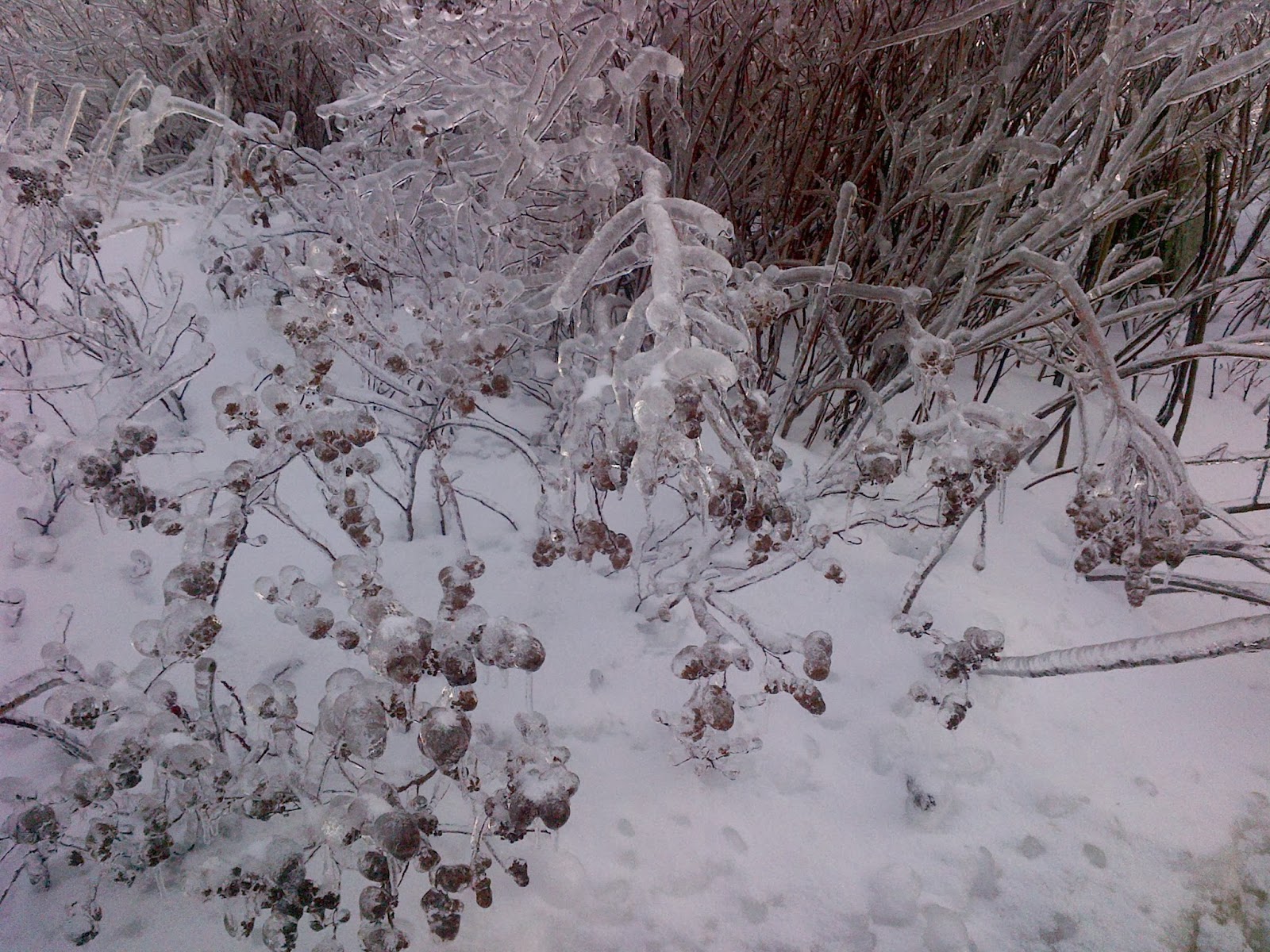
This winter has already been a bit of a challenge to everyone in this area- more snow in three weeks than usual for December with some days reaching -15 degrees of chill... not counting the wind. The ice storm a few weeks back was stunningly pretty, but horrendously destructive as the weight of its icy beauty pulled trees into trees into deep waist-ed bows until they collapsed under their weight , acknowledging their submission to the elements and powers around them. I watched bushes literally collapse in upon themselves- imploding into their cores like a black hole had developed at their roots and was pulling them quickly and inexorably into the nothingness. I lay awake one night gazing blankly at the ceiling and just listening to the creaks, groans, whistling and popping of the many pieces of topiary and the woods in general as they fought and struggled not only for their limbs, but for their very lives. It felt a little bit like the end of the world... the sensation of the earth and all life starting to collapse and die into extinction. It was hard not to feel sad at the death and destruction that I can see from every window of my house and on my walks into the woods. It looked like a war had been fought... and that mother nature had lost, brought figuratively to her knees in surrender. Only one thing spoke of positive things: the small inlet in the woods under some trees with the clear prints and indents of at least five deer who have rested out the storm and then left, alive and ready to look for food.

The one drawback to moving into my awesome cabin at the very beginning of winter is that I had no time to locate and fix any areas or fissures in the walls, windows or doors that might need to be repaired. Most of the time I haven't really noticed – the stove keeps the place warm and cozy and I find myself quite comfortable. I have found that while the insulation is good, the windows are very thin and two of them have broken frames and so in small places, a steady stream of air flows in from the exterior. The wind and snow come in on three sides and I can't feel the cool draft in through the plugs in the wall as well. So when the weather is in negative numbers, it has actually been more of a struggle to keep the place well heated. I will say that even with this difficulty I smile – I just love living here and I feel like I have finally found my refuge... a place to regain my health and to allow the wounds of the last few years to heal. I have slowly been filling in some of the cracks and covering the openings in the windows with tape and down blankets to hold it all tightly together until better weather. That has helped a lot and has even provided more evening entertainment as some of the cats find it less challenging to run up the walls now. :)

So, we are all hunkered down and ready for three more months of snow and ice and wind. And as I drive slowly to work three days a week I look at the houses and neighborhoods as I slide past. The buildings seemed closed off too... covered with snow and ice... hunched or and oppressed, waiting for the warmth to return. How are things in your neck of the woods? Are you and your neighbors warm and comfortable? How is the winter affecting you and your plans? If you survived the ice storm, who did it affect the trees and wildlife around your home? I am very curious!