Showing posts with label Ukraine. Show all posts
2015/02/13
Genocide Denial - the Midianites and the Holodomor
I am still trying to decide for myself what the term' genocide' means with all its nuances and difficulties, but I feel pretty secure in saying that I do not believe that there is a lot of middle ground in the definition. If you have a desire/intent to rid yourself of a group of people specifically for something that they 'are' or what they have, it's genocide in my definition- no matter how successful you were at doing so. I take issue with the term 'somehow less genocidal' because genocide = genocide period. Causing the death of people for their politics is just as much a genocide as doing so for the excuses of race or religion. As we have studied this semester, I have found myself going back to things I have read or heard about that dilute the intensity of the word genocide by excusing or diverting the conversation away from the facts. An example is the attempted extermination of the Midianites by the Israelites in antiquity. The Israelite and their prophet Moses were frustrated by growing religious tensions between the two groups of people and that some Israelites were converting or following teachings that came from the Midianites religion. The God of the Israelites told Moses to kill all of the Midianites and the Israelite armies were sent out and conquered their foes returning home with all of enemy's property/ livestock as well as the women and children who survived the battle. Accordingly, when the soldiers returned to Moses with all the bounty, he is angry and tells them to kill everyone but the virgin girls. That was done and the passage ends with ritual purifying.
Some apologists suggest that God – and therefore Moses- only allowed the virgin girls to live because they would have had nothing to do with idol worship and that was why everyone else had to die. Others state that killing and war were necessary evils at the time and this was normal behavior. At least one source suggests that as Midianites are mentioned later in the Bible, this couldn't be a genocide because not all of the Midianites were killed- They were able to fight another war with the Israelites later. However, boy children and infants would also have had nothing to do with idol worship and they were killed and if some people managed to escape death that doesn’t make a genocide 'not a genocide'.... it simply changes the evaluation of its success.
Today the Russian government still denies the existence of the Holodomor in Ukraine in 1932-33. (For a brief description and information see here.) I think the fact that the Russian government and diplomats took the time and opportunity to help shape the language of the “Convention on the Prevention and Punishment of the Crime of Genocide' to exclude a 'targeted group' in their country makes one thing really clear to me... the men who helped craft the definition knew that what they did was genocide and so worked to make sure it wouldn't 'qualify'. I frankly find that heinous. I find the denial and the active participation to bury the crime almost as heinous as the original transgression. I believe this partly because I think that people who deny it because they genuinely do not believe the 'crime' happened and believe it has been made up are people that are so ignorant I can feel sorry for their lack of knowledge and understanding. Having a full knowledge and working to deny something for financial motives or to give yourself more credibility in front of other governments and the international community is pretty challenging for me to understand. I also find it provocative that a signatory of this convention who has basically agreed to try to 'prevent and punish actions of genocide in war and peacetime' ... is actively trying to distract the world from their own culpability and failings in the same areas. So to look at the Holodomor as 'somewhat less genocidal' seems a bit distracting and disingenuous; i.e. it's either a genocide or not. The major reason that seems to be given – that Stalin’s plans killed millions... many of whom were not Ukrainian, seems disingenuous at best because what that statement tells me is that those who say it recognize that it is a genocide.... just a much bigger one that encompassed a large 'class' of people rather than just Ukrainians.. (Lastly, I find a small irony in the fact that Russia has politically accepted the existence of the Armenian Genocide in Turkey and denies this one... they seem to be so alike in my mind that every argument to prove the “Great Catastrophe' proves the Holodomor as well.... deportations, false political accusations, government seizure of property, denial of food shipments and journalists, etc...)
That begs the question then as to whether the Holodomor is a genocide or not? The legal definition of genocide includes acts committed with the intent to destroy, in whole or in part, a national ethnical, racial or religious group. Acts include killing or causing serious physical/ mental harm and imposing measures intended to damage the group, prevent re-population and/or forcibly removing youth from the group to integrate them into other populations. When the whole of the Holodomor is looked at in this perspective and broken down, we can see how clearly this 'series of decisions/acts fits into the legal definition. Joseph Stalin created the artificial famine by decreeing impossible quotas on grain/ other food products and tight enforcement of them. When it was obvious that his plan was causing starvation and mass death, he did not change anything about the policy and actively denied food aid offered from other countries. If he didn't know what the consequences were when he started his plan, he certainly had the information to figure it out and stop it as time went by. However, written evidence suggests he knew full well what the consequences would be for the peasants by ordering 'the destruction of the kulaks as a class'. When he was told about what was happening from some of his own men, Stalin was quoted as saying, “Wouldn't it be better for you to leave your post and become a writer so you can concoct more fables!” He created orders to shoot anyone who stole even a small amount of food and reflected that it would be much easier to just deport all the Ukrainians but that wasn't possible. Along with other evidence, it seems clear that the intent to kill and demoralize the Ukrainian population has been proved. The Holodomor included millions of deaths as well as serious mental and physical harm as has been testified to by the survivors in their stories of cannibalism, deaths and oppression. Starvation as well as the inability to disperse themselves to safer areas also curtailed births as family relationships and communities collapsed. The Holodomor fits the definition of genocide without any difficulty. It is regrettable that its existence is still being denied and a source of contention between Russia and the Ukraine. The challenges that both countries are going through now seem to stem from the same problems and ideas that caused this genocide in the first place. Moving forward from a place of contention doesn't seem like a great way to move forward... more like a way to potentially have another serious conflict arise again that has the potential to turn into a genocide. I hope that will change… another genocide would be more than tragic, it would be… I just don’t have the words…
pictures from: http://freethoughtnation.com/moses-and-the-midianites/, http://www.patheos.com/blogs/tinseltalk/2012/01/was-moses-black-urban-daily-proposes-black-actors-for-spielberg-biblical-epic/, http://rt.com/news/holodomor-famine-pirozhenko-ukraine/, http://ocfordarfur.wordpress.com/2008/09/
2014/07/19
Dangerous Rhetoric
Yesterday, I found myself in an unusual situation in more ways than one. As I couldn't sleep, I went to the gym before work... way too early in the morning and found myself running on a treadmill in front of four television screens. The irony is of course that I haven't owned a television in over a decade and so experiences with one are few and far between... but four! It's a bit like being offered piles of riches that you don't think you need and are confused as to why others think they are valuable. This opportunity gave me an interesting opportunity for reflection and experimentation.
As most everyone in the first world probably knows by now, an airplane manned by pilots employed by Malaysian Air was shot down and crashed near Grabovo, Ukraine. With 298 people on board flight MH370 - all who perished- the only thing that seemed known immediately was that everyone on the plane died and that the plane was shot down over eastern Ukraine along the border to Russia. So as I jogged on the treadmill, I looked up at the screens and over the next few minutes I realized my opportunity- all four televisions were showing news from four different stations; ABC, FOX, CBS, and NBC. So for a girl who doesn't watch news, I was able over the course of over a hour to watch all of them at once and really compare their coverage of the situation. And even from a lack of experience as a news hound, what I found wasn't really surprising.
On three of the stations, the story seemed to be covered pretty thoroughly, but also with some caveats. As the news was raw, the situation just unfolding and with very little confirmed information. Only the confirmed facts were given definition and were described in definitive terms – all passengers were dead, the flight, where it went down, etc... After that, the language was was more vague... “Investigations are underway, the black box might be, etc... There were pictures... frankly, terrible and devastating photos and descriptions from eyewitnesses that felt so painful and hard to hear. But not a lot of speculation or opinion. And there would be breaks from this tragedy- each station took time to talk about other events such as wildfires, the situation in Israel and Gaza (just as horrible a problem I might say), the indictment of FedEx over shipping medications illegally and gold found in a shipwreck off the coast of South Carolina. And more such as a court overturning another gay marriage ban, the typhoon headed toward China... The world is a big place with much going on in it.
The same could not be said of FOX news. While they seemed to have the same details, it was pretty astonishing to me with how they used them. Small lettering on the bottom of the screen would say the 'facts', but the people talking didn't give any facts without a lot of supposition and even things that were only opinion.... Most of he time they didn't bother to mention any facts that I was learning from the other stations. I felt the anger of the commentators but I was also impressed by how neatly they could draw me in and if I hadn't been able to see the facts from other sources at the same time, I may never had gotten them. The wording that was used was also extreme and violent in its own right. It is no exaggeration to say that every sentence spoken, every word that was said seemed conveyed to expressed three points and only those three points.
1. That this tragedy was caused by the Russians and ordered by Vladimir Putin himself.
2. That President Obama must 'break' Russia and Putin to show the Russians and the rest of the world that we are the mightiest and must be feared and obeyed. That war, violence, 'blood', all have been caused by the evil that is Russia and we the good must vanquish it.
3. If we as America do not do this, we will all die and only terror will win.... with Russia and Putin as its leaders.
All the rhetoric made me think... and with was terrible. Some of the words still burn in my head over twenty four hours later. “Russia has their fingers printed all over this all ways”.... Really? How do we know? (Don't get me wrong, I suspect that in many ways this comment is true about this situation, but...) And then pictures of John F Kennedy and Ronald Reagan would show up on the screen with some of their words in quotes about bringing down Russia, tearing down communism and its evils... and then “The President must, he must... Eye to eye, toe to toe, he must stop them... whatever means are necessary.” “President Obama must show them what happens when Putin sheds the blood of innocents... and perhaps the most ironic quote that sticks in my mind came from Geraldo Rivera- “I told you yesterday Putin has blood on his hands.” Yup, the same guy that my friends and I used to laugh at in high school who five days a week make the term 'talk show' synonymous with interviewed strippers, skinheads, white supremacists, families who hated each other, etc.... He's now reinvented himself as a political commentator. So I was able to listen to him wax poetic on the evils and wrongs by Putin- many of which must have been exaggerated...something he used to do on his talk show... he was well known for it.
I am no friend of Vladimir Putin. I do not know him and am aware that living in this country I will not have many opportunities. It has been obvious to me for years that as America and Russia are enemies, the media in this country can never really see anything that has to do with Russia unbiasedly. We as a people are still trying to understand their history and their culture without coloring it through the lenses of our biases and prejudice. And we are doing it poorly. This experiment cemented two things into my head. First of all, I have heard to the polls and studies that show that those who get the majority of their information from Fox news are more ignorant of the reality of the world than people who get their news from anywhere else. But it also explained the constant fear and anger I sense in so many of the people I know who are 'die hard' FOX news fans. How can you not be when you sit and listen to so much anger... and so much falsehood or at least unproven accusations that when they are proved false ... will never be redacted. That language is dangerous for all of us- even those of us who do not hear it. We have to live with the pain and anger it causes in others, many of whom we care about. After over an hour yesterday of interaction and attention, I will avoid giving any of my time to that station again. I only wish that so many others could see it for what it is. There is enough hate and anger in the world as it is without manufacturing more.
Yesterday so many died in a plane crash.... in the conflicts in Gaza, in Africa from malaria, in Syria... everywhere. So many people are frightened and sad and unsure what to do in their lives. In fact, some numbers suggest that 1 in five of the dead in Gaza are children- children may sometimes be called little terrors but very few people would call them terrorists worthy of death. Instead of creating anger, fear and division, couldn't we work together to grieve and to fight it, fight the terror and the pain with an equal amount of love and good will as well as the basic law enforcement stuff? I can only hope.....
Labels:
Barack Obama,
communism,
death,
experiment,
Fear,
FOX News,
Friend,
Geraldo Rivera,
ignorance,
Israel,
John F. Kennedy,
Malaysia,
politics,
Ronald Reagan,
Russia,
terror,
Ukraine,
Vladimir Putin,
world
2013/11/29
Term Post #3 : The Holomodor of Ukraine
“The aim of censoring regimes is to purge historiography in order to make it a tool of the ideology justifying the rulers' position of power”
The Holodomor is the name given to the famine in the Ukraine in 1932-1933. The name means 'Hunger Extermination' and even today, it is not lawful to use certain words when describing it inside Russia – it's very existence was denied by the Soviet Union until a few years before the collapse of the government in the late 1980's. Estimates of the numbers of dead are variable due to the suppression of information available from the Soviet government and accessible to study, but a general consensus is guessed at around three million people. Adam Ulan, the director of the Russian research center at Harvard, estimates the loss of life at 5-7 million Ukrainians while other sources suggest that up to fourteen million may have died. (Clearly without more information that is unknown at this time, a more specific and appropriate number can not be defined.) Before this time, Ukraine was considered a part of the Soviet Union and was also starting to have a strong nationalist movement forming that was hopeful for independence from Russia and the Union. It was also at the death of Lenin in 1924 that Josif Visarionovich Dzhugashvili – more commonly known as Joseph Stalin- was able to cement his rise to power over Russia and its unified territories and gain full control over both the government and its propaganda wing, the Communist Party. Once in power, Stalin began a campaign of 'five year plans' to rapidly advance industrialization and modernity into the Soviet Union and its people. The first Five Year Plan contained provisions that removed the individual farmer from the control of their land making the land consolidated property of the state and forcing peasants/farmers to either move to cities and work in the rising industries or continue to farm on the new 'collectives' with new tools and rules. It is thought that the Stalinist government hoped to suppress and control the growing Ukrainian nationalist movement as well as individual support systems that could be used for revolt against them. These were the circumstances/national policies that set the stage for the coming famine and genocide.
With the new policies of land appropriation, things turned challenging for people very quickly. Some of the more well to do farmers burned off their crops refusing to join the collective farms causing many farmers (also known as Kulaks) to be deported to concentration camps to die leaving fewer people to farm. They were also branded as 'enemies' encouraging both the official law enforcement and other citizens to 'liquidate' them as a class. A decree requiring production quotas was passed and so in most cases all grain and food products that were produced were taken by the government for export to gain money to increase the speed of industrialization... living little to nothing for the populace itself to eat. In fact, as the quotas were unable to be met, government representatives were sent to villages to look for hidden food- a true irony as they would walk past those dead or dying of starvation in their search for just a little more food to sell to Europe.
When the starvation became evident, it was seen by Stalin and many in power the result of the peasant's failure to work adequately within the new collective system. Examples of that way of thinking can be seen in the many accounts given by survivors. When a Chairman of the Village Soviet was informed of the many deaths that happened in a village in the county of Cherkasy, the chairman was said to have not wanted to believe the 'story', to object to the use of the word 'starved', and to say that the only deaths that could have happened were to the idle, the lazy, and those who refused to work in the collective farms who needed to be exterminated anyway as “enemies of the people”. Yet one observer during this time stated that peasants in the Ukraine had resorted to 'eating dogs, horses, rotten potatoes, the bark of trees, grass-anything they could find... and no matter what they did, they went on dying, dying, dying.” The writer Isaac Babel returned to Moscow after visiting the famine stricken Ukraine and he told a friend that some of the things he had seen were impossible to speak or write about including cannibalism. It seemed to be impossible for those in power or with a strong belief in the ideology of the Communist party to see that the policies of 'progressive humanity' could fail … it could only fail as a result of enemies from without and so the 'five year plan' and the system itself continued to move forward creating not only more death, but endless numbers of enemies would be created by the numberless individuals who were starving. Between the torture and death of his political opponents as well as citizens, Stalin can rightfully be called one of the most successful mass murderers in history.
During this time frame, the Soviet government strongly curtailed freedom of expression and used censorship to try and control the information that was able to be discussed. Many who spoke of the existence of the famine were imprisoned or executed and the official state talking points were of consistent denial that the famine existed at all. This strict code to denial went so far as to also refuse any food aid that other countries did try to send to the individuals in the Ukraine. Information that was given out to other countries relied on these particular talking points, and so even in the United States, Stalin's propaganda and misinformation of the famine was spread. New York Times correspondent Walter Duranty wrote during the crisis: “Any report of a famine in Russia is today an exaggeration of malignant propaganda. There is no actual starvation or deaths from starvation, but there is widespread mortality from diseases due to malnutrition.”
The changes that the Hunger Extermination brought to the Ukraine were far reaching and are still in work today. Initially, it destroyed the Ukraine's political leadership and also changed the demographics of the population between the deaths and the encouraged resettlement of other Russian ethnic groups into the affected areas. (Even the capital city of Ukraine had been changed from Kharkiv to the city of Kiev where it remains today.) It helped bring the separatist nationalist movement to the core of Ukrainian politics, history and identity. Any effort to have the Holodomor recognized by the United Nations as an act of genocide is heavily resisted by Russia and so the politics over the situation continue on into the current relationships of both countries; many other countries have acknowledged the Holomodor as genocide or as a 'deliberate act of famine' by the Soviet authorities. (The U.N. has recognized that the Holomodor was “a national tragedy of the Ukrainian people caused by the cruel actions and policies of a totalitarian regime.”) While this was certainly not the first major challenge that the inhabitants of the Ukraine had with Russia, it seems to have certainly caused the most pain and remembrance in large swaths of the population. In some ways the Holodomor is still a censored topic: when looking for sources for these writings, I found many books on the history of Russia and the Ukraine that mentioned the Holodomor only as a famine and in one or two short sentences... easy to be missed and forgotten. Other changes that have happened that now have international consequences due to this and other massacres committed or sanctioned by other dictators such as such as Mao Zedong in China, Augusto Pinochet in Chile and Pol Pot in Cambodia, is that the International Criminal Court has been developed and no longer (with some exceptions) allows national sovereignty to be the reason that dictators can commit atrocious acts against their own citizens. The system is no where near perfect, but it is much better than nothing.
We still have the challenges of censorship and genocide in our world today. Discovering how to combat it and use speech to attempt to not only right the wrongs that have been perpetrated but to also attempt to keep genocide and atrocities from happening is something that many scholars and individuals still debate today. How much secrecy can a government have and still allow full freedom of expression? How much openness can we have as a society and still have security? How much of either are permissible to be restricted to keep the majority of people safe, secure, and also free? It is a debate that I suspect will continue long into the future... as long as human beings continue to exist.
I hope you enjoyed... or at least learned something new. Not a topic that can really be enjoyed, is it....
2013/11/26
It's Done.... Thank Goodness! An Introduction to the Next Three Posts :)
Whew! My term paper for the torture class is done and turned in. I am going to post it here but I will break it up into three different sections as follows due to length:
Post #1 - Censorship, Freedom of Speech and how they can contribute to Genocide
Post #2 - the Irish Potato Famine / Irish genocide
Post #3 - the Holodomor in the Ukraine
I'll post one a day so if you find the paper interesting... well, you won't have to wait long for the rest :) Let me know what your thoughts are!
(My several pages of sources are available to anyone who asks. :)
Post #1 - Censorship, Freedom of Speech and how they can contribute to Genocide
Post #2 - the Irish Potato Famine / Irish genocide
Post #3 - the Holodomor in the Ukraine
I'll post one a day so if you find the paper interesting... well, you won't have to wait long for the rest :) Let me know what your thoughts are!
(My several pages of sources are available to anyone who asks. :)
2011/03/23
The First Romanov Czars: Michael and Alexei (1613-1676)

The accession of Mikhail Romanov to the Russian throne in February 1613 marked the end of the 'Time of Troubles' for the Russia country. A few ideas survived this time stronger and intact which was to affect the Russian country politically for centuries to come. The idea that only a strong monarch/tzar could keep the country from chaos was strong and seemed to many to be the only alternative to ongoing chaos. One idea was that the only stability that had been available was the Orthodox church and that was the only guarantee and unifying factor in Russia without a Tsar. There was also the idea that the person who should be in charge needed to be of the 'people' and understand the hardships that they had faced... and were facing. Last was the realization that the Tsar needed the boyar class and could not have authority without them- they would have to work together or get nowhere but trouble, death and chaos for all. The person also needed to be acceptable to the majority if not all Cossack groups as well as the boyar class. Finding someone on the Rurik hereditary line that hadn't been involved in the intrigue and choosing sides in the long civil war was that much harder. So it comes as almost no surprise that the chosen individual was young, had the appropriate heredity, and had very little political involvement over the last fifteen years. A quote from a source that caused me to laugh- “The choice (for czar) fell upon a boy, whose name might have wrung a sigh from the ghost of Boris Godunov: Michael Romanov.” I think the author was right! This paper will discuss the reigns of Tsar Mikhail I and his son Alexei I of Russia. It will discuss their goals and achievements and help us continue on our enlightening path of learning Russian history.
Mikhail Fyodorovich Romanov was born on July 12, 1596 to Feodor Nikitich Romanov and Kseniya Shestova in Moscow, Russia. Very little else is known about his childhood. It is known that both of his parents were forced by Boris Godunov to enter service in the church to keep them out of sight/mind for the 'succession'. Before taking vows and being known as Patriarch Filaret, Feodor Romanov had been a distinguished soldier, a man of diplomacy and had been the popular candidate for the throne when Feodor I passed away and Boris Godunov took over. The young Michael probably grew up in a convent with his mother at Tolvuysiy pogost and then later moved with her to Kostroma. In February 1613, he was the chosen and elected czar.... but the next step was for the new czar to be found. And found he was at his mother's side at the Ipatiev Monastery near Kostroma on March 24th. (On a side note, there is a legend about a man named Ivan Susanin who was tortured to hide the whereabouts of the young Michael Romanov and because of his faithfulness and his silence his ancestors were given one half of Derevischi village by Tsar Mikhail.... or he led a Polish army group sent to capture the czar astray and they were never heard from again. There is some debate about this.) Many sources suggest that Mikhail and his mother were not accepting at first of his new 'elevation'- only after much discussion did Michael accept the position of Czar. He approached Moscow on May 2,1613 and several weeks later he attended his coronation in the Assumption/Dormition Cathedral. He married Maria Vladimirovna Dolgorukova in 1624 and when she died four months after their marriage, Michael married Eudoxia Streshneva. Together, they produced ten children including the next Czar Alexis.
The first priority of the new Tsar in 1614 was to restore order and rid the country of the 'foreign occupators'. One source suggests that Tsar Micheal’s main goal was actually twofold- to rid Russia of the large foreign armies and put to rest the conflicts with Poland and Russians as well as deal with his country's financial problems to help solidify Michael's own position. Due to his age, he ruled closely with close consultation with the Boyar Duma and the Assembly of the Land for the first few years... and well as help by his mother's relatives that took control of governmental affairs until the return of Mikhail's father. Patriarch Filaret returned to Moscow in June of 1619 and took up the reigns of political affairs, accepting the title of Great Sovereign and ruling until his death in 1933. However, before his father's return Mikhail had many accomplishments. He had inherited a bankrupt country and he immediately borrowed money to pay the army and raised taxes. Michael was able to put down an uprising of an pretender (false Dmitri III) and his promoters which helped to cement his rule. After the necessary isolation of Russia during the civil wars of the 'Troubles', Tsar Michael looked to England and to its monarch James I for an alliance that could protect Russia from further problems with Poland- there was precedent for good relations with England as relations between the Queen of England (Elizabeth I) and Russian monarchs Ivan IV and Boris Godunov were mostly amiable. This step, along with the taxes and rebuilding the army ended parts of the Polish occupation of Russia and helped control the Swedish threat. Tsar Mikhail signed the Treaty of Stolbovo in 1617 and the Treaty of Deulino in `1618. The alliance with England was successful in its ambitions and both parties (the Tsar of Russia and the King of England) gained many of the priorities and securities that they wanted in their high stakes game of 'risk'. Throughout the last years of his rule, the czar's concentration was on colonization and fort-building in the south and in Siberia- as well as the reformation of the structure of local governments to increase the authority of the central administration. Tsar Mikhail Romanov ruled until his natural death of illness on July 12, 1645 after naming his 16 year old son Alexei as his designated heir.
Alexei Mikhailovich Romanov was born on March 19, 1629, to Tsar Mikhail and his second wife, Eudoxia Streshneva. Alexis was brought up by various wet nurses until the age of five and then his education was entrusted to two boyars names Boris Morozov and Basil Streshnev. Even though he was handed the throne at the same age as his father, he had been able to be better prepared for the challenge. He was sixteen years of age when his father died on July 13, 1645 and his coronation was held on September 28, 1645. In Russian, his nickname was 'tishaishii' which means 'most quiet one' and he was known to be a very devout and religious man. (The word 'tishaishii' can also mean 'the most meek.) Tsar Alexei relied heavily on his two tutors for advice during the early parts of his reign, but firmly stood on his own during much of his reign. He married Maria Ilynichna Miloslavskaya in January 1648 and she gave birth to thirteen children in their twenty-one years of marriage... and died a few weeks after the last childbirth. It was said that Tsar Alexei was very grief-stricken at her death, however, he did later marry again; a Nataliya Kyrillovna Naryshkina and after their marriage in February 1671, she bore him three children... including Peter, who would later be known as one of the greatest Russian rulers in history.
No one can really honestly suggest that the time frame during the rule of Tsar Alexei was not tumultuous. Events happening all over the globe confirm that statement. But Russia itself was part of and participated in some of the difficulties. In Russia during his reign, Tsar Alexis faced numerous town rebellions including defeating the Cossack group led by Stenka Razin, fought and was fairly successful territory-wise in the Russo-Swedish war of 1656, a thirteen year war with Poland which was quite successful territory-wise, as well as a permanent schism in the Orthodox church. According to the introduction to his own book on falconry, Alexis is quoted as saying that "everything must be done with good order, discipline, and exact arrangement.” One source mentions that this quote helps explain the tzar’s emphasis on centralization, obedience, and conformity. He believed that nothing could be secure or strengthened unless great care, strong consistency and hands on strong authority was used. This was not a whim that he expected others to follow alone- Tsar Alexis required the same behavior in almost all instances from himself. Alexei is also quoted as coining the phrase “a time for work, an hour for play” which is still a popular saying in Russia.He was considered one of the most educated men of his time and he himself wrote and edited many of the important decrees and documents of his time for Russia. He was the first czar to sign laws on his own authority and to permit realistic portraits of himself as well as to actually receive personal communications as a 'person' and not as a leader. Tsar Alexei also established an international postal system to improve communication with other states in Europe. He was described in the memoirs of Lizek as a “Tsar [that] is gifted with unusual talents, has fine qualities and rare virtues... subjects love him so much and revere him.” A monument to Czar Alexei is scheduled to be completed in the city of Penza in 2013 which is the city's 350th anniversary- this city is significant as it was built on Czar Alexei orders to bolster one of the Russian empire's borders.
Tsar Alexei was a man who seems to have a broad vision and unlike some of his predecessors, didn't seem to enjoy the punishments that he felt 'forced' to order. His actions increased the territory of Russia and also helped cement the autocracy for his successors... giving them more power than he had come to the throne with. When he died, he left a fairly stable country ready to accept some new western ideas and a lasting legacy. His son Peter I would continue and build on his father's ideals and legacy creating a legend for himself and a country that would continue to last until this very day.... even if in a smaller form.
2011/02/18
The Subjugation of Kievan Rus : The Tartar-Mongol Conquest and its Influences/ Ramifications
The Tartar- Mongol invasion of 1237-1241 marked the collapse of the Kievan Rus state and for more than a century, the Mongolian leaders and armies remained the major power over most of the Rus territories. For almost the next 300 years, the three major influences on this country and its people were the Mongols, the new city of Moscow, and let's not forget the Russian princes and aristocracy that will continue to weave their influence, civil war, and conflicts onto the Russian people and its land mass. This paper will discuss the Tartar -Mongol invasion and the Russian resistance to it and also will discuss the history of the “Golden Gate” of Kiev and its significance to Russian history and the Mongol invasion.
By the time of the beginning of the Mongol invasion in 1237, many things had changed in Kievan Rus. The city of Kiev was no longer the capital of the 'great prince' Andrei Bogolyubsky as he had 'sacked' the city and then moved 'his' capital to the city of Vladimir. As the trade to Greece became less important, so did the city of Kiev and eventually steppe nomads (the Polovtsy) cut the water route to Greece. This waterway 'tie' had connected the two largest areas of Kievan Rus... and they were now divided. Decentralization and migration to avoid the steppe nomads began to occur and ordinary Russians, as they understood the inability or unwillingness of their princes to rule, took to finding their own strength to solve their problems and to try and prosper. This lack of communication and the lack of cooperation by the ruling elite left the Kievan Rus state more vulnerable to outside invading forces. This vulnerability and then the loss of several armies that were sent to help neighboring Polovtsky forces fight the Mongolian forces, helped assure the collapse of the Kievan Rus and the takeover by the Mongols.
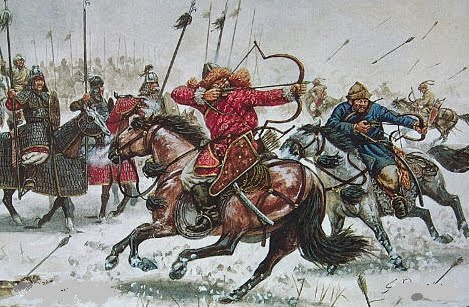
Russia was safe for a few years from the Tartar-Mongols as the Mongolian forces retreated to the East in 1227 to deal with internal problems arising from the death of Genghis Khan....however, these were dealt with and so the Mongols returned, invading under a khan named Batu and a general named Subodei. While the Russian elite and its people should have been prepared for the Mongols to return, the Riurikid princes failed to take any extraordinary precautions against attack – even after three of their neighbors were attacked and subdued in 1229 and 1232. Batu and his army attacked in 1237 by crossing the Volga river and systematically taking over the land after his demand for a tribute of 10% of all the assets of Russia was denied- which included people and horses. The first to fall was the city of Riazan which was conquered in a week, destroyed the small town of Moscow in January 1238, 'captured, plundered, and burned' the city of Suzdal, and then reached the city of Vladimir in February- which was defeated and beaten in a battle on the Sit' river on March 4, 1238. The great Tartar-Mongol campaigns in the lands of Russia can be divided into two separate phases over three years (1237-1240).

By 1240, Batu had conquered all but a single part of the Kievan Rus- and Novgorod escaped only by a very lucky circumstance. As new territories were acquired, the Mongols conscripted new members for the military from the conquered populations and adapted their 'clan structure' to the conquered people. The Mongols were also noted by religious communities at the time for being very tolerant of other religions. However, the Mongols were not noted for their abundance of mercy or pity- to themselves or other groups of people. An example of the strict discipline by this group for themselves can be measured the the example given to other soldiers – if one or more soldiers was 'captured' by the enemy, the other members of their military 'group' were executed after the battle's end. Also, in “The Tale of the Destruction of Riazan”, the audience is reminded that the Mongols 'burned this holy city with all its beauty and wealth... And churches of God were destroyed and much blood was spilled on the holy alters. And not one man remained alive in the city. All were dead. All had drunk the same bitter cup to the dregs. And there was not even anyone to mourn the dead.', After the Mongol military campaigns were concluded in the Rus lands, these lands joined the vast empire that was known as the Golden Horde- which at its largest point covered large areas across eastern Europe, Persia, China and Korea.
The land of Kieven Rus and its people were deeply affected by the invasion and subsequent rule by the Mongol rulers. Looking at the land through a large lens, the country itself was mostly cut off from Europe for more than 250 years. This would certainly have had its effect on the economy- as well as the political and cultural structure of the time. After the city of Kiev was burned to the ground in December 1242, the center of political power in the Rus was shuffled from there to the newer city of Moscow. (An interesting chronicle account on the siege and burning of Kiev mentions that so many people tried to get to safety from the Mongol army in the Church of Tithe that the upper floors of the church collapsed due to the weight. The Church of Tithe was also the first church built of stone in the city of Kiev.) At the time of the Mongol destruction, Kiev was considered one of the largest cities in the world, with a population exceeding one hundred thousand. Many parts of the land and its human geography was destroyed as cities were burned, large quantities of people killed, several royal princes killed along with their armies, and a new way of life and new leaders emerged. (There is some argument about how much real damage either than 'deaths' the Mongol conquest actually caused.) The only facts that do not appear to have much dissent surrounding them is that the Tartar-Mongol forces seemed to easily and speedily conquer the Kievan Rus state due to a few circumstances- the Mongol army was much larger and much more efficient due to skill, military tactics etc.... The Russians had no central command, smaller and less efficient armies, no intelligence system and very little communication between the towns and districts.
With the coming of the Khan- ruler or tsar of the Golden Horde, the lives and lifestyles of the remaining populations were to change. The Mongol society was primarily a nomadic one and that was not to change after the takeover of a different group of people. Society was based around clans, which were then divided into tribes and then smaller groups and even when building cities and agricultural communities, the Mongols were known for continuing to be a people who were easily 'transportable'- while building his capital city of Sarai, the leader Batu lived in a tent. One source suggests that by 1253, this capital city was an enormous 'tent city' of about ten miles in size. The economy was affected as tribute needed to be paid to the Mongol oppressors, qualified men were forced or conscripted into new positions in the economy- army, crafted items, other skilled labor, etc... Some chronicles describe the taking of slaves and the systematic conscription of the skilled craftsman and artisans. So internal commerce would have suffered a setback due to the lack of city craftsman to make things to sell, the inability of the towns to make goods to satisfy the villagers, the Mongol policy of 'ignoring' the peasants so that the peasants would be forced to grow food for themselves and the trade routes that had been disrupted and needed to be restored, etc... To be blunt, the Mongols, who were primarily interested in economic gain, had the motivation to get the economy moving again quickly and settle in peaceful relations over the conquered. That said, the motivation was based on what the Mongol leaders wanted the economy to do... and that did not necessarily contain what the economy had already been functioning as before the war.
Politics changed as well. The war with the Mongols had reduced the number of princes that still survived to vie for power and land (mostly the northeastern princes). And each of these princes needed to accept their new rulers, learn how to deal with the new rules/laws and attempt to recover and restore order in their lands- of course, after they had their right to continue to 'rule' confirmed by the Khan. The fact that the Mongols had become the men in charge, however, did not change the continuous power struggles between the Russian princes as well as the near severance of political and cultural ties between the north and south lands. In some areas the only outward sign of the Tatar-Mongol invasion's success was that the Russian princes would travel to the headquarters of the Golden Horde to pay allegiance to the Khan and have their appointments as leaders confirmed... as well as to pay tribute. The invasion also brought the 'census' to Russian lands as the Mongol leaders used the information gathered for military conscription, land division, assessing the amount of tribute due, etc... Politics in general changed more in the southern areas of the old Kievan Rus due to proximity to the headquarters of the Golden Horde- the northern areas were less easily influenced. Diplomatic rituals clearly changed and developed over this time as well. The visits became more formalized and became a 'ritual'... and not a haphazard system.
Other changes that can be attributed to the Mongol invasion were changes in culture. A postal system was developed that helped speed communication and make it more efficient. Interactions between the Church and the Golden Horde became more direct and regular at time went on and by 1261 a bishopric was established at Sarai and the Russian church was afforded special privileges from taxation and military conscription- even though the Mongols were generally Muslim. Individual bishops could serve as diplomatic agents for the khans and were used by the Golden Horde to help improve alliances with the Byzantium as well as act as emissaries to the Russian princes (which could suggest church approval for the Mongols.) As the city of Moscow became more prominent over time, the culture that the city of Kiev had shared diminished and the cultural attributes of Moscow became more widespread. (By 1252, Moscow had become an independent hereditary principality and over the next hundred years it was to grow strong enough to not only annex some of its neighbors in 1302, but to also fight for the title of Grand Princedom in the early 1360's.) Over time, the Golden Horde would put it's trust/confidence in the prince's of Moscow over other political princes.
Like all empires, the Golden Horde was chipped at over time and was eventually vanquished from the Russian lands. In 1380, an alliance led by the princes of Moscow defeated the mongols at the battle of Kulikovo- which was to mark the beginning of the end of the Golden Horde in Russia. The Mongol 'vacuum' as filled as it lifted, but mostly by Russia's traditional enemies (the Poles and the Lithuanians) and not necessarily by the Russian's themselves. As these new groups moved in, intermarriage became more commonplace, helping to blend, people, cultures, and language.
In conclusion, while the Mongol invasion caused changes in the economic, political and cultural structure of Kievan Rus- and certainly contributed or caused the failure/collapse of the state, not all changes can be placed squarely at the feet of the Golden Horde. For some groups economic advantages could be had that were better than before the invasion... and many economic hardships that were suffered by the common man could be shown to be as much the fault of the Russian princes themselves as well as the Mongol leaders. The changes in culture can be placed at the feet of the Mongols... and at the feet of the Russian princes and the Byzantine empire as well. And many political 'changes' didn't cause much change at all- the Russian princes still squabbled like toddlers playing a high stakes game of Risk. Some changes, such as the census and tax gathering methods the princes saw as distinct benefits- and kept using them after the Khan had been vanquished from the Russian lands. Moscow rose to prominence because of the calculation of its princes and their use of the 'political arraignments by the Golden Horde- a calculation that other princes in Russia didn't take advantage of.
An interesting side note to this invasion and physical structure that has managed to survive the years of changes and revolution is the “Golden Gate' of Kiev. Who constructed the gate is up to debate- whether it was Vladimir I or his son Yaroslav the Wise- although Yaroslav appears to be winning in the debate. It was constructed in 1017-1024 and served as a main gala entrance to Kiev. The Golden Gate was originally a 'triplet' and was one of the three main gates into the city of Kiev. The other two have not survived the onslaught of centuries. The city of Vladimir had a set of gates also known as the 'Golden Gates', but those particular gates were destroyed by Batu during the Mongol invasion of the city. The Golden Gate of Kiev, however, was built so well that when Batu tried and successful attacked the city of Kiev, he was unable to get through that particular gate... and only found success through a less well fortified area. These 'gates' have a few significant connections to the past history of the Russian state. In 1048, a french delegation arrived in the city of Kiev to ask King Yaroslav for his daughter's hand in marriage to King Henry I of France. The french diplomats was awed by the beauty of the “Golden Gates” and you can still find royal deeds in France signed with the seal of the Princess Anna Yaroslavna- which has a iris and a gate... which is thought to be the Golden Gates of Kiev. If all the entrances to Kiev had been like the Golden Gate...well, the Mongols might have met their match in the city of Kiev. It is also a unique architectural structure that has been imitated a few times, but is based on the internal decorations found in ancient Ruthenian churches. Currently, the Golden Gates have been restored on the ruins of the original gates, holds a museum inside and are now the property of a different nation- Ukraine.
By the time of the beginning of the Mongol invasion in 1237, many things had changed in Kievan Rus. The city of Kiev was no longer the capital of the 'great prince' Andrei Bogolyubsky as he had 'sacked' the city and then moved 'his' capital to the city of Vladimir. As the trade to Greece became less important, so did the city of Kiev and eventually steppe nomads (the Polovtsy) cut the water route to Greece. This waterway 'tie' had connected the two largest areas of Kievan Rus... and they were now divided. Decentralization and migration to avoid the steppe nomads began to occur and ordinary Russians, as they understood the inability or unwillingness of their princes to rule, took to finding their own strength to solve their problems and to try and prosper. This lack of communication and the lack of cooperation by the ruling elite left the Kievan Rus state more vulnerable to outside invading forces. This vulnerability and then the loss of several armies that were sent to help neighboring Polovtsky forces fight the Mongolian forces, helped assure the collapse of the Kievan Rus and the takeover by the Mongols.
Russia was safe for a few years from the Tartar-Mongols as the Mongolian forces retreated to the East in 1227 to deal with internal problems arising from the death of Genghis Khan....however, these were dealt with and so the Mongols returned, invading under a khan named Batu and a general named Subodei. While the Russian elite and its people should have been prepared for the Mongols to return, the Riurikid princes failed to take any extraordinary precautions against attack – even after three of their neighbors were attacked and subdued in 1229 and 1232. Batu and his army attacked in 1237 by crossing the Volga river and systematically taking over the land after his demand for a tribute of 10% of all the assets of Russia was denied- which included people and horses. The first to fall was the city of Riazan which was conquered in a week, destroyed the small town of Moscow in January 1238, 'captured, plundered, and burned' the city of Suzdal, and then reached the city of Vladimir in February- which was defeated and beaten in a battle on the Sit' river on March 4, 1238. The great Tartar-Mongol campaigns in the lands of Russia can be divided into two separate phases over three years (1237-1240).
By 1240, Batu had conquered all but a single part of the Kievan Rus- and Novgorod escaped only by a very lucky circumstance. As new territories were acquired, the Mongols conscripted new members for the military from the conquered populations and adapted their 'clan structure' to the conquered people. The Mongols were also noted by religious communities at the time for being very tolerant of other religions. However, the Mongols were not noted for their abundance of mercy or pity- to themselves or other groups of people. An example of the strict discipline by this group for themselves can be measured the the example given to other soldiers – if one or more soldiers was 'captured' by the enemy, the other members of their military 'group' were executed after the battle's end. Also, in “The Tale of the Destruction of Riazan”, the audience is reminded that the Mongols 'burned this holy city with all its beauty and wealth... And churches of God were destroyed and much blood was spilled on the holy alters. And not one man remained alive in the city. All were dead. All had drunk the same bitter cup to the dregs. And there was not even anyone to mourn the dead.', After the Mongol military campaigns were concluded in the Rus lands, these lands joined the vast empire that was known as the Golden Horde- which at its largest point covered large areas across eastern Europe, Persia, China and Korea.
The land of Kieven Rus and its people were deeply affected by the invasion and subsequent rule by the Mongol rulers. Looking at the land through a large lens, the country itself was mostly cut off from Europe for more than 250 years. This would certainly have had its effect on the economy- as well as the political and cultural structure of the time. After the city of Kiev was burned to the ground in December 1242, the center of political power in the Rus was shuffled from there to the newer city of Moscow. (An interesting chronicle account on the siege and burning of Kiev mentions that so many people tried to get to safety from the Mongol army in the Church of Tithe that the upper floors of the church collapsed due to the weight. The Church of Tithe was also the first church built of stone in the city of Kiev.) At the time of the Mongol destruction, Kiev was considered one of the largest cities in the world, with a population exceeding one hundred thousand. Many parts of the land and its human geography was destroyed as cities were burned, large quantities of people killed, several royal princes killed along with their armies, and a new way of life and new leaders emerged. (There is some argument about how much real damage either than 'deaths' the Mongol conquest actually caused.) The only facts that do not appear to have much dissent surrounding them is that the Tartar-Mongol forces seemed to easily and speedily conquer the Kievan Rus state due to a few circumstances- the Mongol army was much larger and much more efficient due to skill, military tactics etc.... The Russians had no central command, smaller and less efficient armies, no intelligence system and very little communication between the towns and districts.With the coming of the Khan- ruler or tsar of the Golden Horde, the lives and lifestyles of the remaining populations were to change. The Mongol society was primarily a nomadic one and that was not to change after the takeover of a different group of people. Society was based around clans, which were then divided into tribes and then smaller groups and even when building cities and agricultural communities, the Mongols were known for continuing to be a people who were easily 'transportable'- while building his capital city of Sarai, the leader Batu lived in a tent. One source suggests that by 1253, this capital city was an enormous 'tent city' of about ten miles in size. The economy was affected as tribute needed to be paid to the Mongol oppressors, qualified men were forced or conscripted into new positions in the economy- army, crafted items, other skilled labor, etc... Some chronicles describe the taking of slaves and the systematic conscription of the skilled craftsman and artisans. So internal commerce would have suffered a setback due to the lack of city craftsman to make things to sell, the inability of the towns to make goods to satisfy the villagers, the Mongol policy of 'ignoring' the peasants so that the peasants would be forced to grow food for themselves and the trade routes that had been disrupted and needed to be restored, etc... To be blunt, the Mongols, who were primarily interested in economic gain, had the motivation to get the economy moving again quickly and settle in peaceful relations over the conquered. That said, the motivation was based on what the Mongol leaders wanted the economy to do... and that did not necessarily contain what the economy had already been functioning as before the war.
Politics changed as well. The war with the Mongols had reduced the number of princes that still survived to vie for power and land (mostly the northeastern princes). And each of these princes needed to accept their new rulers, learn how to deal with the new rules/laws and attempt to recover and restore order in their lands- of course, after they had their right to continue to 'rule' confirmed by the Khan. The fact that the Mongols had become the men in charge, however, did not change the continuous power struggles between the Russian princes as well as the near severance of political and cultural ties between the north and south lands. In some areas the only outward sign of the Tatar-Mongol invasion's success was that the Russian princes would travel to the headquarters of the Golden Horde to pay allegiance to the Khan and have their appointments as leaders confirmed... as well as to pay tribute. The invasion also brought the 'census' to Russian lands as the Mongol leaders used the information gathered for military conscription, land division, assessing the amount of tribute due, etc... Politics in general changed more in the southern areas of the old Kievan Rus due to proximity to the headquarters of the Golden Horde- the northern areas were less easily influenced. Diplomatic rituals clearly changed and developed over this time as well. The visits became more formalized and became a 'ritual'... and not a haphazard system.
Other changes that can be attributed to the Mongol invasion were changes in culture. A postal system was developed that helped speed communication and make it more efficient. Interactions between the Church and the Golden Horde became more direct and regular at time went on and by 1261 a bishopric was established at Sarai and the Russian church was afforded special privileges from taxation and military conscription- even though the Mongols were generally Muslim. Individual bishops could serve as diplomatic agents for the khans and were used by the Golden Horde to help improve alliances with the Byzantium as well as act as emissaries to the Russian princes (which could suggest church approval for the Mongols.) As the city of Moscow became more prominent over time, the culture that the city of Kiev had shared diminished and the cultural attributes of Moscow became more widespread. (By 1252, Moscow had become an independent hereditary principality and over the next hundred years it was to grow strong enough to not only annex some of its neighbors in 1302, but to also fight for the title of Grand Princedom in the early 1360's.) Over time, the Golden Horde would put it's trust/confidence in the prince's of Moscow over other political princes.
Like all empires, the Golden Horde was chipped at over time and was eventually vanquished from the Russian lands. In 1380, an alliance led by the princes of Moscow defeated the mongols at the battle of Kulikovo- which was to mark the beginning of the end of the Golden Horde in Russia. The Mongol 'vacuum' as filled as it lifted, but mostly by Russia's traditional enemies (the Poles and the Lithuanians) and not necessarily by the Russian's themselves. As these new groups moved in, intermarriage became more commonplace, helping to blend, people, cultures, and language.In conclusion, while the Mongol invasion caused changes in the economic, political and cultural structure of Kievan Rus- and certainly contributed or caused the failure/collapse of the state, not all changes can be placed squarely at the feet of the Golden Horde. For some groups economic advantages could be had that were better than before the invasion... and many economic hardships that were suffered by the common man could be shown to be as much the fault of the Russian princes themselves as well as the Mongol leaders. The changes in culture can be placed at the feet of the Mongols... and at the feet of the Russian princes and the Byzantine empire as well. And many political 'changes' didn't cause much change at all- the Russian princes still squabbled like toddlers playing a high stakes game of Risk. Some changes, such as the census and tax gathering methods the princes saw as distinct benefits- and kept using them after the Khan had been vanquished from the Russian lands. Moscow rose to prominence because of the calculation of its princes and their use of the 'political arraignments by the Golden Horde- a calculation that other princes in Russia didn't take advantage of.
An interesting side note to this invasion and physical structure that has managed to survive the years of changes and revolution is the “Golden Gate' of Kiev. Who constructed the gate is up to debate- whether it was Vladimir I or his son Yaroslav the Wise- although Yaroslav appears to be winning in the debate. It was constructed in 1017-1024 and served as a main gala entrance to Kiev. The Golden Gate was originally a 'triplet' and was one of the three main gates into the city of Kiev. The other two have not survived the onslaught of centuries. The city of Vladimir had a set of gates also known as the 'Golden Gates', but those particular gates were destroyed by Batu during the Mongol invasion of the city. The Golden Gate of Kiev, however, was built so well that when Batu tried and successful attacked the city of Kiev, he was unable to get through that particular gate... and only found success through a less well fortified area. These 'gates' have a few significant connections to the past history of the Russian state. In 1048, a french delegation arrived in the city of Kiev to ask King Yaroslav for his daughter's hand in marriage to King Henry I of France. The french diplomats was awed by the beauty of the “Golden Gates” and you can still find royal deeds in France signed with the seal of the Princess Anna Yaroslavna- which has a iris and a gate... which is thought to be the Golden Gates of Kiev. If all the entrances to Kiev had been like the Golden Gate...well, the Mongols might have met their match in the city of Kiev. It is also a unique architectural structure that has been imitated a few times, but is based on the internal decorations found in ancient Ruthenian churches. Currently, the Golden Gates have been restored on the ruins of the original gates, holds a museum inside and are now the property of a different nation- Ukraine.
Labels:
Anna Yaroslav,
culture,
death,
France,
Golden Gates of Kiev,
Kiev,
Kievan Rus,
medieval history,
Mongol,
Moscow,
Novgorod,
politics,
Russia,
tsar/tzar,
Ukraine,
Vladimir I of Russia,
Yaroslav I of Russia (the wise)
2011/02/07
The Late Kievan Era: Vsevolod III and the Early Development of Ukraine

During the reign of Vladimir I, the country-state of Kievan Rus was brought into stability, Christianity, as well as economic security. After his son's were placed in positions of power in cities around the state with ready militias and some autonomy, it looked as though Kievan Rus was ready for a golden age of peace and prosperity. This was not to be and right before his death in 1015 AD, Vladimir's many sons began to fight for more control, larger land areas and supreme power over all as well as wealth. This bloody infighting continued with little respite as different princes began to exert more control over their lands and fight off invaders- whether 'relative' or foe. For almost one hundred years, brothers killed brothers and other relatives with a few brief periods of stability between periods of strife and civil war. The next ruler of note was Vladimir Monomakh in 1113 AD. However, by 1132 Ad, Kievan Rus was beginning to seriously divide and fragment due to internal tensions between the differing princes and the city of Kiev could no longer be counted on to produce an occasional strong and unifying ruler. Other economies and other political centers began to assume more importance during this time including the cities Vladimir-Suzdal (in Suzdalia), Galicia-Volhynia, and Novgorod... and another hundred years of various times of vague calm and civil war were to commence. During this time, a large period of relative calm and economic success was brought about by the rule of Vsevolod III. He lived from 1154-1212 and was known as the 'Grand Prince' as well as by the name Vsevolod the 'Big Nest'- due to his fourteen children. In this paper, I will discuss the life and successes of Vsevolod III, some of the reasons for his success, and the populating of the lands we now call Ukraine- or “the breadbasket of Europe”.
Vsevolod was one of the children of Yuri Dolgorukivi who is known as the founder of the city named Moscow around the year 1156.(Yuri I) It is not known exactly who is his mother was (he was the 10th/11th of fifteen known children, but historical speculation suggests his mother was Helene Komnene, a Greek princess who took Vsevolod with her to Constantinople after his father's death. It was in Constantinople at the Komnenoi court that he spent his childhood, returning to Kievan Rus in 1170 and possibly visited Tbilisi where he might have met his future wife. Before 1186 Vsevolod married his first wife, Mary Shvarnovna of Ossetia- she bore him 14 known children and died in 1206. Mary devoted her life to works of 'piety' (and clearly having children!) and was later glorified as a saint in the church. In either 1207 or 1209, Vsevolod married Liubov Vasilkovna, the daughter of Vasilko Bryacheslavich who was Prince of Vitebsk- they had no children that are known.
During the early parts of his reign, Vsevolod participated in many military struggles and was not known for being merciful. He increased his holdings by strengthening the defenses on the middle Volga, building outposts along the northern Dvina, seizing towns from Novgorod, and appropriating its lands along the Upper Volga. He had limited success, however, in bringing Novgorod itself under his control. He put people in charge of areas who would do his will and was not accepting or tolerant of disobedience. He was known as a great military commander and in “The Tale of Igor's Campaign” it is written - “Great prince Vsevolod! Don't you think of flying here from afar to safeguard the paternal golden throne of Kiev? For you can with your oars scatter in drops the Volga, and with your helmets scoop dry the Don.” For the church, he was much more generous and in his capital city of Vladimir he had built the Cathedral of St Demetrius in 1197. When the Assumption Cathedral was destroyed by a large fire in 1185, he had it rebuilt under his direction. And around the year 1200, his wife Mary founded the Princess Convent presumably with his blessing.During his life time, he was acknowledged as the dynasty's senior prince, but Vsevolod focused his attention on his lands and of the neighboring principalities of Rianzan and Murom. His sons, following their father's example, devoted themselves to their northern concerns and withdrew from 'southern' politics. Vsevolod III ruled for 36 six years until his death on April 14, 1212 of natural causes at the age of 58 (a rare way to die for a military man!)
So by 1200, the northeastern area of Kievan Rus known as Suzdalia had become quite important... and its ruler Vsevolod III had dominated the other princes in the south for the over quarter century that he had been in power. There are a few clear reasons that Vsevolod III was able to be so successful in his quest for power and wealth. One important reason was his luck of geography- Suzdalia had many rivers including control of most of the upper Volga river. Some of these rivers flowed in and out of neighboring territories which gave Suzdalia an opportunity to act as a middleman between other states that their ruler did not hesitate to take advantage of. In addition, the soil of the area was rich and fertile. Agriculture was easier to develop in this area than in other parts of the Kievan Rus state. When you also add the fact that Suzdalia had fewer problems with foreign enemies than some of its southern counterparts- and by the 12th century, its primary enemy the Volga Bulgars were on the defensive and less likely to attack.... it is not surprising that many new cities sprang up in this state. All of these factors would have made migration to this area quite attractive to many people which can also help explain how the population grew so quickly around this time. Most of the migration appears to be Slavic populations moving to the safer areas to avoid the constant incursions by nomadic tribes that continued in the south. It should also be mentioned that because the Suzdalia area was an area of high migration, it gave the princes more power than the rulers of the older, more entrenched areas. Trade would have been a good reliable source of income during this time with fewer enemies, lots of 'controlled' rivers and waterways, more individuals to make or grow goods, and the possibility of acting as a middleman on some rivers to neighboring states. An 18th century Russian historian named V.N. Tatishchev states “the Volga Bulgars were constantly trading in Suzdalia where they sold grain, valuable objects, cloth and other goods around the Volga and Oka.” Other sources suggest that trade was a very common occurrence during this time before the Mongol invasion.
The territory that we now call Ukraine still has almost all of the same geological benefits that were exploited during the time of Vsevolod. The soil is still rich and will produce large high-quality yields. It had heavy forests in the twelfth century which would have been used for housing, heat, and trade. It had plenty of rivers for drinking water, agriculture and animal husbandry, travel, etc... Animals for fur and/or food would have been fairly easy to find as well. Add the idea that this area would be mostly safe from invaders and it would be hard to imagine why everyone in the area didn't move there! And several sources describe the rich and frequent trade in this area... as well as the thriving culture.
I found a few things interesting when I was researching this paper. For instance, I laughed out loud at finding a genealogy website that showed the links between George Washington and Vsevolod III... and all sorts of others! I was also amused to find that this great man has his own Facebook page- it doesn't look like it is updated frequently, but...wow! And one site helped me to place this time frame with more clarity in my mind because it linked the year of Vsevolod's death with the failure of the children's crusades- I think one of the worst parts of history that I have ever studied... or at least the worst ideas I have ever heard of. The Suzdalia state sounds like it had many places in which it would be possible to work for a living, enjoy some medium of safety and also have the opportunity for culture. This was a really fascinating research project... and so I look forward to the next one!
Labels:
Christian,
control,
culture,
facebook,
family history,
genealogy,
history,
Kiev,
Kievan Rus,
medieval history,
Mongol,
Moscow,
Novgorod,
politics,
Russia,
Slavic,
Ukraine,
Vladimir I of Russia,
Vsevold III of Russia
Subscribe to:
Posts (Atom)